Many promotional product distributors operate without a formal account planning process.
Accounts are managed based on experience, instinct, and day-to-day activity. While this approach may work temporarily, it often creates inconsistency across teams and leaves significant growth opportunities undiscovered.
As distributors grow larger and accounts become more complex, the lack of structure becomes increasingly costly.
Strategic account planning solves this problem by creating a disciplined framework for managing key relationships intentionally rather than reactively.
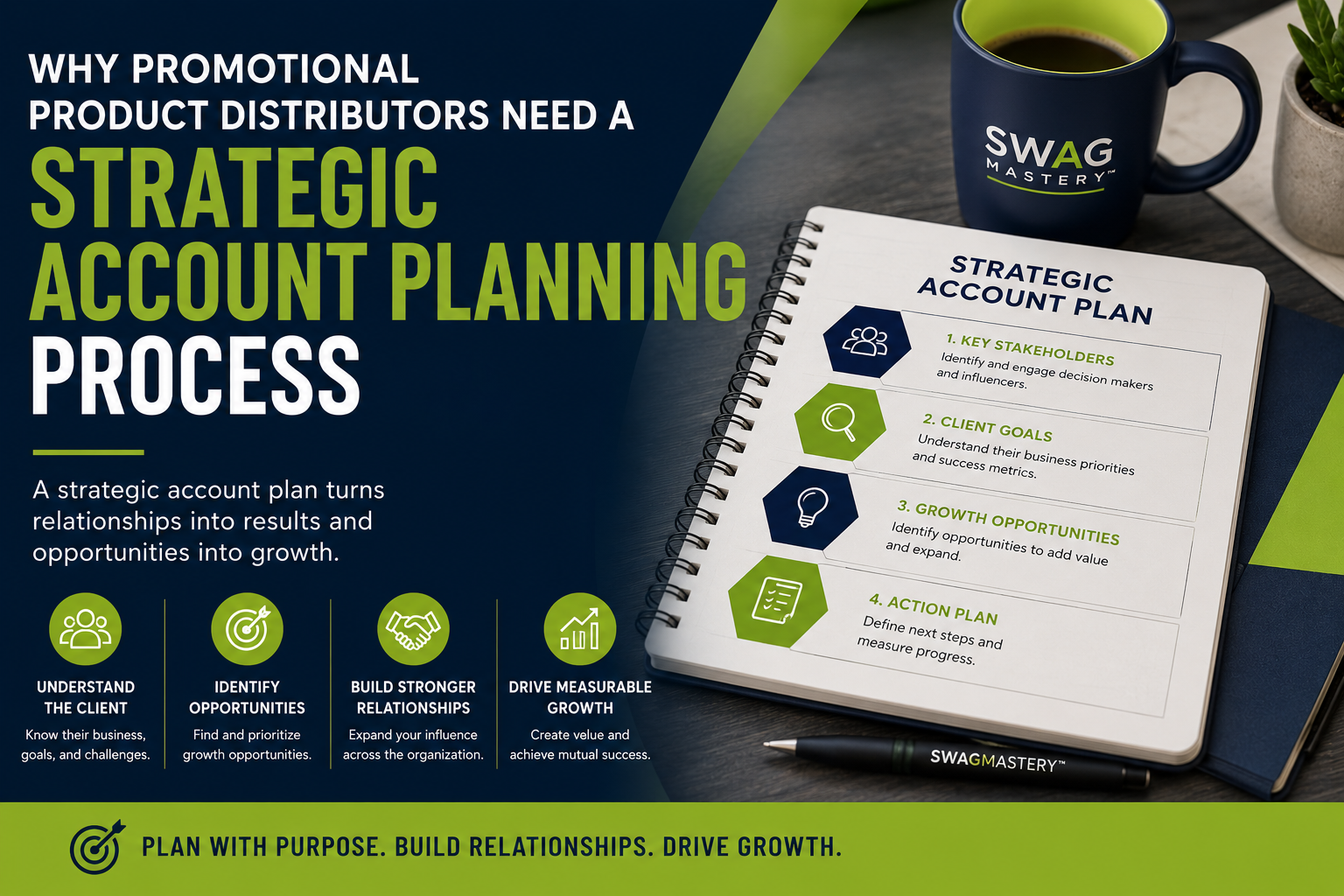
At its core, strategic account planning is about understanding where growth exists inside an account and developing a structured approach to pursuing it. Instead of simply waiting for projects to appear, distributors proactively identify opportunities, stakeholders, and long-term initiatives.
This changes the nature of the relationship completely.
One of the most important benefits of account planning is visibility. Many distributors only understand a fraction of their client’s organization. They may have strong relationships with one contact while remaining disconnected from other departments that also use promotional products.
A strategic account plan helps uncover those additional opportunities. Marketing, HR, procurement, events, and sales teams often have completely different needs and priorities. Mapping these departments creates a clearer picture of where growth potential exists.
Strategic planning also improves resource allocation. Not every account deserves the same level of investment. Some clients offer far greater long-term value due to revenue potential, relationship depth, or strategic alignment. Account planning helps organizations identify which relationships justify deeper focus and dedicated growth strategies.
Another advantage is consistency across teams. Without shared planning frameworks, every account manager develops their own methods and processes. This often leads to inconsistent communication, uneven execution, and unpredictable results.
A structured planning process creates alignment. Teams understand how accounts are evaluated, how growth opportunities are identified, and how success is measured.
This consistency becomes especially important as organizations scale.
Strategic account planning also improves retention. Clients are far less likely to leave when the distributor has built relationships across multiple stakeholders and developed long-term initiatives tied to the client’s goals. Replacing that type of partnership becomes difficult because the relationship is deeply integrated into the organization.
The financial impact can be significant. Accounts managed strategically often generate higher lifetime value, stronger margins, and more predictable recurring revenue streams.
Most importantly, strategic planning shifts the distributor’s mindset from reactive fulfillment to proactive partnership.
That shift may be one of the most important competitive advantages available in the promotional products industry today.